|
 |
| |
The
reception of The water drop - on TV2 News |
|
Dear friends.
Thank you so much for this award. What can I say about building
bridges between people who would rather hide in their bubbles? So
let me, inspired by Jens Galschiøt's beautiful water drop, try
the opposite of bubbles.
From my work with the Ku Klux Klan, I want to talk about how small
drops can turn into waves that infect others—both in the US and
here at home.
 |
 |
| Klan leader Jeff Berry was at that time the leader of
the largest klan group in the US and the only one who had ever
had the courage to march in Manhattan, New York, as
seen here. |
Before
traveling around with Mads Ellesøe. |
When the
award-winning film director, Mads Ellesøe, heard about my bridge-building to
the US's
largest Klan leader,Jeff Berry, he got the crazy idea to make a film
about "the racist and the anti-racist" traveling together to visit my old black friends.
But it didn't go entirely smoothly and nearly destroyed my
long friendship with the clan leader.
Because dialogues must take place in secret, not in front of cameras!!!
After a few days, the atmosphere was so toxic that the two couldn't be
in the same room.
Mads thought Jeff was a disgusting manipulator.
Jeff thought Mads was a pathetic liberal snob.
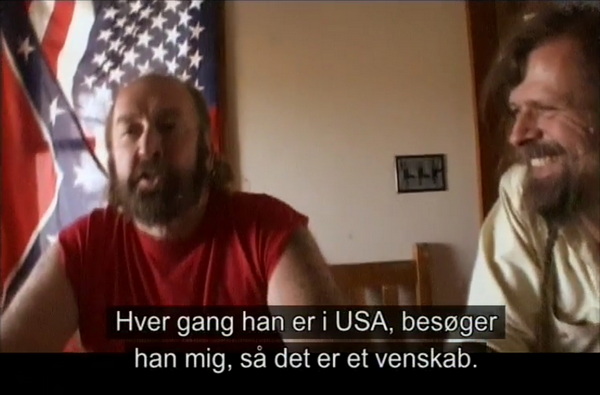 |
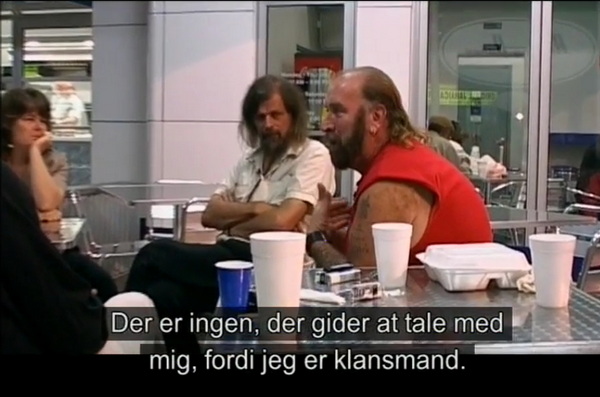 |
| Clip from the film |
Clip from the film |
We could only afford one motel room, so when Jeff had to sleep in my
car, I was honestly nervous that in his rage he would run off
with both the car and my equipment.
So I forced myself to say:
you have to trust in the best in people, otherwise the
worst will take over.
Finally, the furious clan leader exploded.
We shouted so loudly in a square in Alabama that the whole state could hear
it.
 |
 |
| Jeff furiously packs
his bags to walk home along the country road. |
Beforehand,
he had called the members of |
When Jeff wanted to go home, I physically stopped him. He raised
his fists—but I moved closer and said calmly:
"Jeff, you are not violent. I know you are good at heart."
Mads looked at me as if I were insane. But I
knew
it.
I had seen the same rage in many of my black friends in the
ghetto. Behind the hatred there was always something else – a wound, a pain.
And if you dare to stay long enough, you can get there.
Jeff actually came back with me. And that evening something happened that I
couldn't have planned.
As I tried to catch my breath outside the motel, a woman called out
in the darkness:
"So, you got some trouble there?"
Ireplied, "Yes – and I can hear – that you do too!"
Her name was Cristy Warren. A poor, white drug-addicted prostitute – and before
I knew it, I ended up in bed with her and a bottle of vodka
right after her furious breakup with a black customer.
 |
 |
| Cristy during
our nightly session in the protective position I
recognized from Nell |
Jodie Foster
in a similar position in the film. Shortly after
her breakthrough in "Taxi Driver," she had participated in my racism
workshops at Yale University, where I signed my book for
her |
She kept curling up protectively like
Jody Foster in
the movie Nell about her fear of rape, and when I mentioned this,
Cristy gradually opened up throughout the night.
She was from a Ku Klux Klan family, but had been sexually abused
by almost her entire family. As a child, from the age of three
old.
At fourteen, she ran away from home, ended up as a drug addict and
prostitute – but was taken in by a loving black family and
now found herself the only local white member of the
violent black gang,TheCrips.
Moved, I listened all night as she talked and cried and laughed and
gestured like Nell in the movie.
And when the sun rose, I thought:
This woman can save our film project.
So the next morning, she took us to visit her Klan father.
 |
 |
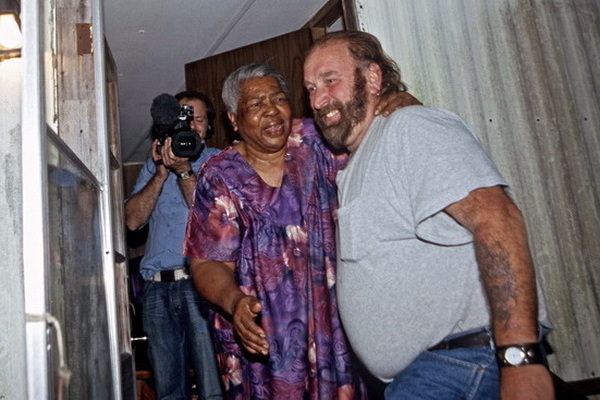
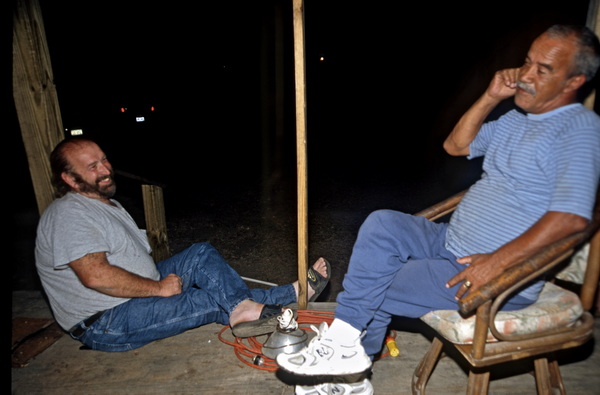
| We arrived at Cristy's father's,
Bob Warren, in front of his rotten trailer |
Bob with the dogs |
He lived in a shabby trailer with three dogs, trash everywhere, and a
wild look in his eyes.
When I heard him use the "N-word" about low-trash people who take from
society without giving anything back—
both white and black—
Jeff lit up. Because they were "my people," as he always
self-deprecatingly said, using the exact same definition of the N-word about
poor white people.
He would now do anything for Cristy's sick father there in his black/white
ghetto, and I could sense that something in Jeff was beginning to change.
(The N-word here refers to the old hateful
American term, not in the common Danish meaning).
 |
 |
| It was difficult
to have a quiet conversation with the barking dogs, but Jeff immediately felt
at home with Bob in all his poor mess |
Cristy
loved her father, and I took lots of pictures like this
of them together |
 |
 |
| Robert (Bob) on his views on
the Ku Klux Klan |
Visiting
Cristy at a neighbor's house, who supported the clan but had never
learned to read.
Cristy had already become very attached to me.
|
But the real redemption came the next day.
I asked Mads to take the camera and lots of beer with us to a forest, where we
spread out blankets.
I sat Jeff down opposite Cristy and said:
"Now I'm going to tell you Cristy's story. Listen – with all your
compassion."
I began to tell him. About the whole evening before – the abuse,
the pain, the suicide attempts, everything.
I felt my own voice break into tears.
Cristy cried, and eventually tears rolled down the hardened
cheeks of Jeff, even though he fought to keep up his facade.
Then he got up without a word and walked deep into the forest.
I thought he was gone forever.
But he came back.
And when he sat down again, I said:
"Jeff, you know that's your story too. Not just sexually –
but the same beatings and humiliations you got as a child.
Your drug-addicted prostitute mother who never
saw you
while her men beat you.
All the things you never want to talk about, the pain you still struggle with.
You just hide in the Klan while Cristy hides in America's
most violent black clan."
He didn't say anything. But I could tell that the words had gotten through to him.
The rest of the day was one big mutually cathartic conversation, as if they
had both been waiting their whole lives to be seen and heard.
(Ps. This part was not included in Ellesøe's film,
"Jacob and the Clan," because the tape with the scene was lost. We assumed
that Jeff had stolen it from the car).
 |
 |
| When
the clan leader proudly served me breakfast in bed and
told me about saving my life. Now I understood why
he had come out in the middle of the night and woken me up with
the words, "Jacob, can I borrow one of your books?" |
Two years earlier, in
2004—after his release from prison, where I had
told Jeff during a visit that I let my criminal black
friends in the ghettos sell my book as an alternative to
selling drugs, he said, "Now that I don't have a job,
can't I also be allowed to sell your book, Jacob?" And
that's how I got a clan leader to sell my anti-racist
book. Both he and I were amused by our new constructive collaboration. |
Ironically, I myself was also "saved" in a way.
At the sex worker Cristy's motel, we were visited by a black gangster
friend who sold her heroin.
He became paranoid and thought I was a cop because I still had
a microphone in my shirt from the film shoot.
While I was sleeping in the car, he sat inside with Jeff and Cristy and became so
paranoid from the heroin they were cooking that he threatened to shoot me
with his gun.
Jeff, the clan leader, saved me by showing the gangster my book
American Pictures,
full of photos of me with black criminals.
"Look, Jacob isn't a cop," Jeff said. "He's one of you."
When
I woke up the next morning, the Klan leader served me coffee in
the car bed and said proudly:
"I just saved your life, brother. That's what the Klan is for."
&##128522;
And
I thought:
that
is some damn good high-level bridge building!
TWO YEARS LATER
Two years later, Jeff invited me into his own bed.
Now he had changed.
Because after our bridge-building trip to my black friends, he went home
and disbanded the entire Ku Klux Klan.
Whereupon the other Klan members tried to kill him.
He survived two months in a coma, and now blind and paralyzed,
he preached love in a church instead of hate in a forest.
 |
 |
The article on
Wikipedia about the clan members' (including Jeff's own son)
assault on him. He was in a coma for two months, and the doctors
did not believe they could save him.
This is also mentioned here on Wikipedia after his death in 2013. |
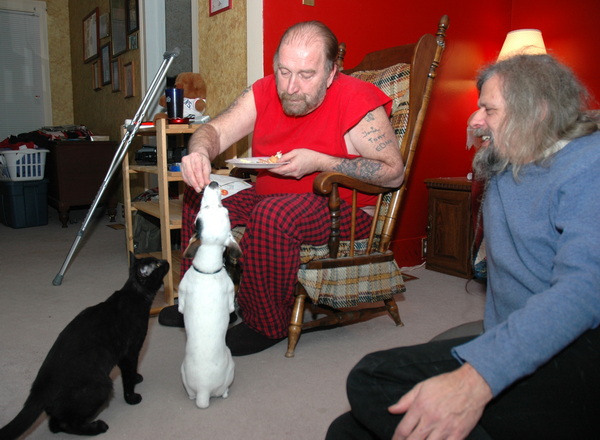
Visiting
the now paralyzed (crutch in the background) and completely blind Jeff. But
he could still hear the difference between black and white on
television, he claimed.
During my long video interview, he now claimed that it was not
him who had stolen the TV tape with perhaps the most
crucial moment in his conversion. |
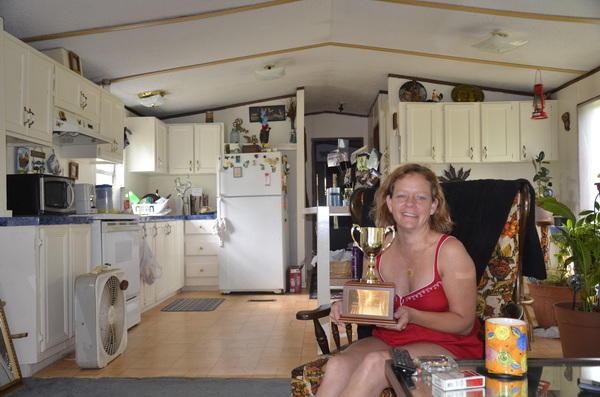
And Cristy? She moved away from her black
gang under police protection, changed her name, got out of her addiction – and had just won
an award as the best student at her university when I last
lived with her in 2011.
 |
 |
 |
 |
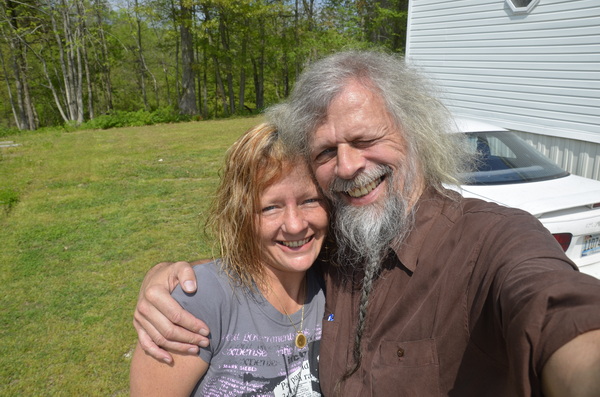
My
last visit to Cristy in 2011, after she had moved with
police protection away from her black gang
Crips and started an education program—and won this award
as best student. |
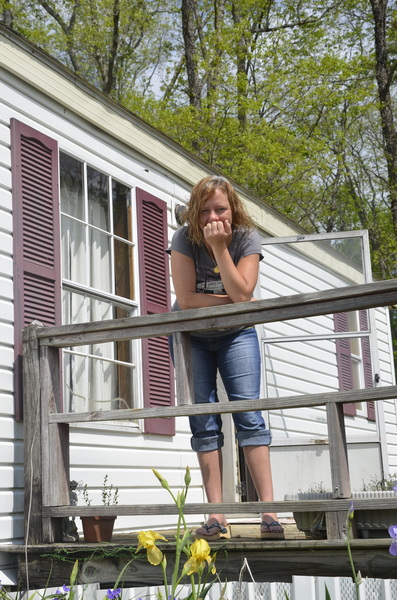
But see
below what happened to her beautiful new house.
|
THE DROP THAT SPILLED OVER
Back home in Denmark, I saw a black Danish woman, Naval, on social media
who constantly called everyone racists – including me.
I thought:
that anger – I know it.
So I invited her to my show
American Images
in Odense.
She shouted and gestured the whole way in the car, but during the lecture
she sat perfectly still for five hours.
So the next day, I invited her to my second lecture
Can We Love the Ku Klux Klan?
Organized for the employees of Danish Radio's deputy director
Charlotte Borg.
It was she who, as a young woman working on
her
first film here, had had the crazy idea of putting me together with the
leader of the largest Klan in the US, Jeff Berry, and thus started it all.
But there was only one room available, so I said a little nervously to
Naval:
"We'll have to share the bed."
To my surprise, she replied —
a Muslim woman from Somalia—
"That's no problem."
:-)
I should have known that
it
meant I wouldn't get much sleep.
Because she drank and partied all night with the DR people, while I tried
to get some rest.
But the next morning, she sat quietly during my three-hour lecture –
and afterwards, in the car, came the revelation.
She told me that as a child in Somalia, she had been constantly sexually
abused by all the men in the family – until she was circumcised at the age of 8
and the family fled to Denmark shortly afterwards.
She told me that she had been an alcoholic and drug addict her entire adult
life – locked up at St. Hans for a whole year – without anyone being able to
help her or her understanding why.
Until she heard me talk about the clan leader's patterns of suffering and about
how
irrational anger is sometimes just grief in disguise.
She said, "I thought I was angry at everyone else as racists. But
I was angry at my own demons."
And I saw that the demons had piled up in a crazy mess in her
apartment.
Later, she came to help me sell books at my lecture.
She was now well-dressed, sober—and had her life in order.
My son visited her afterwards and said to my amazement: "Dad,
her home was completely clean and tidy."
Then I knew she had been set free.
 |
 |
The unforgettable day, May 21,
2010, when I drove Naval home from my lecture at Søby
Herregård near Ringsted. |
Shortly
afterwards, Naval came to visit with his sister, Nasrin, "Would you
be willing to take my sister on a similar
lecture tour?" I did, but on that trip I discovered
that Nasrin had received a high level of education and even a Fulbright
scholarship to the United States. Probably because she was four years younger and
had therefore escaped the pain Naval had been exposed to
in Somalia before fleeing to Denmark.
|
 |
 |
| Naval today |
|
And that is really what I want to say tonight:
That building bridges is not just about
talking to each other
– but about
liberating each other.
And that it – yes, sometimes "transgressive" –
is contagious and liberating from country to country.
As we always said in my workshops between blacks and whites at
US universities,
"If a distress pattern attacks you –
and only a distress pattern would think of doing that –
help is always right at hand.
Namely, from the person who is trapped in the distress pattern
and is waiting to be liberated."
Because behind every shout, every accusation, every wall of hatred, there
is almost always an old pain begging to be heard.
If we dare to listen long enough, ... if we dare to stay, ... then
the miraculous happens: this person turns out to be more like us
than we thought.
The enemy becomes a human being!
And yes, as
I always emphasize to Özlem, especially when you
take the plunge and
"sleep with the enemy!"
😊
Well, the speech was 10 minutes long as promised, Özlem, but I also want to
say thank you.
Thank you to all of you out there who should have received the award instead of me.
Thank you,
Jeff Berry,
up there—for letting me experience your love that for so many years was
locked in irrational anger.
Thank you,
Cristy Warren,
for
your
bridge-building help, which was the drop that also freed you.
Thank you to
JodieFoster,
who eagerly participated in my workshop at Yale University, where I signed my
book for her.
Thank you
Mads Ellesøe
for
your film about how difficult bridge-building is to what we mistakenly call
"
hatred."
Butalso for subsequently sending me on a journey
together
with the far greater challenge, Søren Pind
😊
 |
 |
With Charlotte Borg on the night of the awards ceremony |
With Charlotte Borg and Theis Mortensen |
Thanks to
Charlotte Borg and Theis Mortensen
down there in the hall ... for making me an active member of the Ku Klux Klan
for 15 years, thereby helping to redeem two other Klan leaders who,
unlike Jeff,
really did have blood on their hands.
(See them, Robert Moore and Virgil Griffin, in chapters 1 and 2 here about Love disguised as hate)
And a special thank you to you,
Naval,
up there at the back of the hall,
for the journey you took me on to Somalia and for
passing on the drop in your work with socially vulnerable people.
Thanks to
my son Daniel down there in front,
for
theinspiration you give me as a bridge builder all over the world
after you yourself learned it
as a two-year hitchhiker in the black
ghettos of the USA.
Thank you to
my daughter Lalou,
who as a psychologist went to bomb training and wore a bulletproof vest to
build bridges with Al Shabab's traumatized child soldiers in Somalia – and
twice
being
bombed out of Gaza while working to save its
traumatized children from later joining Hamas.
And yes, thank you to
my forgiving wife Vibeke
down there –
for saving our children during all the years I lived under the illusion
that
I could save the whole world.
And thank you to
Jens Galschiøt
– Denmark's greatest idealist
(currently on his way to the climate conference in Brazil) – for all the times you let me stay overnight
in your workshops where you made this beautiful golden Drop.
And thank you
Bent
Melchior
for showing me that it is never too late to build bridges when you took
me to play soccer with rejected asylum-seeking children – on your 90th
birthday
And thank you to
mylong-time comrade-in-arms Özlem ... with the hope that one
day you will understand that the concept of "sleeping with the enemy"
.....should also
should be included in your Bridge Builder Manual.
😊
Thank you.
But,but, but,
there is a sad ending to this story.
It was important to get all my teammates on board today, but when I
called Cristy in Alabama the other day, I discovered that she is now in
prison.
She has just murdered her father, dismembered him in the bathtub, and—to
hide the murder—burned down the beautiful house where I
last stayed with her.
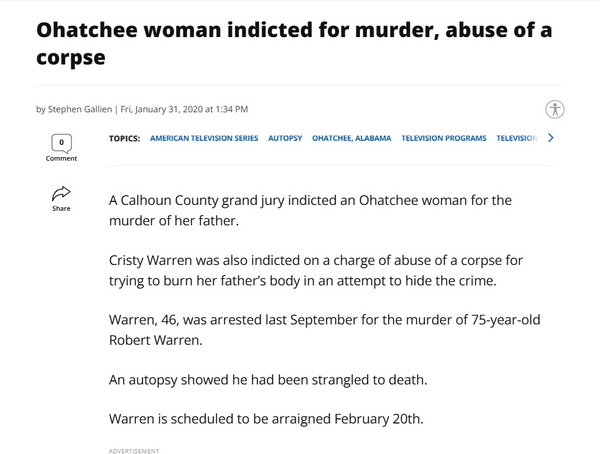 |
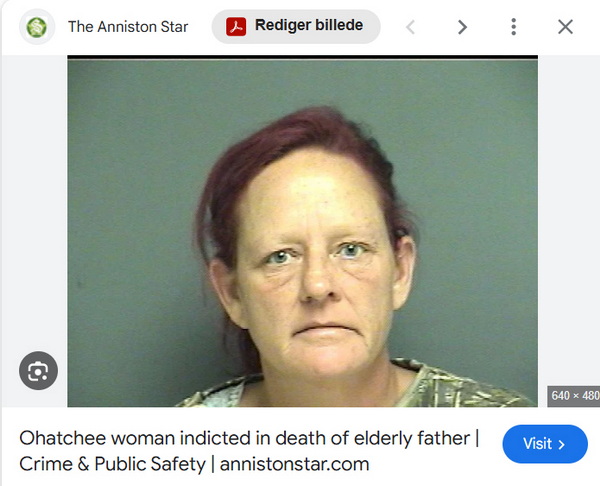 |
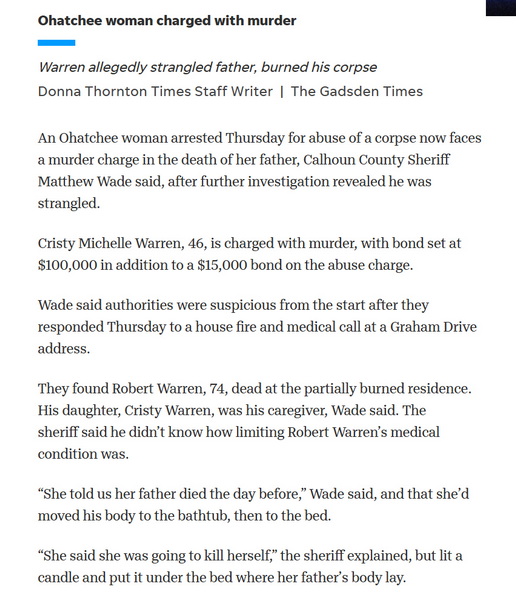
The charges against Cristy
|
Cristy as she now appeared in
the newspapers nine years after my last visit |
 |
 |
Cristy with the traumas in her
childhood room at her clan father's house, where she grew up until
she fled from him and the family |
The charges against Cristy |
But Mads Ellesøe and I saw how much she loved her father—just as
much as she hated him for his clan activities.
During the civil rights struggle, her father, as a young klan member, helped
burn
the famous Greyhound bus with the "Freedom Riders" right there in Anniston,
where he himself was now burning.
 |
 |
 |
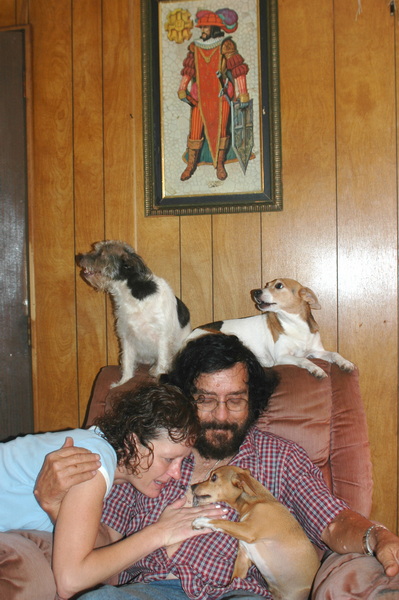 |
| |
My many pictures of Cristy's love for her father |
So I am convinced that this is a mercy killing, and I am now working
with Cristy's defense attorney, using all my photos and
Mads Ellesø's
film "Jacob and the Clan" to convince the judges of her deep love for her father.
She helped us once, now we can help her.
Because building bridges is
always a never-ending "give and take."
But we must never give up the fight—even when the forces of darkness, as
right now in the US, seem to be gaining the upper hand!
Starting tomorrow, you will be able to see my speech here with all the pictures on
the Bridge Builders'
website:
www.american-pictures.com/dansk/artikler/Tale-til-Melchiorprisen.htm
Thank you once again for the wonderful award.
Jacob Holdt |