|
My
father's death
My father's condition had further deteriorated over the
summer vacation, he had lost his appetite and had become far
too thin. I didn't understand it, as I had really kept hope
and faith in the Indian tea I gave him. But now, through one
of my brother's accounting clients, the herbalist Bruce Kyle
in Aarhus, I found out that it was the wrong tea I had
tracked down in the US. A Canadian woman had sold it under
the pretense that it was Rennee Caisse's original recipe,
but then lost a copyright lawsuit while she herself had died
of cancer, which was not the best advertisement for the
product. Bruce put me in touch with a Danish importer of the
real Essiac, Sara Damskier in Brovst (tel. 98-230977 if you
have family members suffering from cancer). I immediately
became good friends with her and have promised to create a
website for her. I now headed over to West Jutland to once
again look after my father and carefully cook the new herbs
for him. And it may well be that it quickly made a
difference. His former huge appetite immediately returned
and I could almost immediately start reducing his
painkillers without causing him any more pain.
Unfortunately, we never found out if it also slowed down the
spread of the tumors because other complications arose, but
it kept me hopeful to the end that “this little millennial
crisis” would be overcome.
Of course,
I had my doubts when I went on nightly visits to my own old
doctor Munck, who has battled cancer himself and told me
that there was no hope for my father. “But it can't hurt
what you're doing,” he added, with most doctors' lack of
faith in alternative treatment. However, the American Bruce
was also a doctor, and with our great shared hope, Steen and
I now set Bruce on a major analysis of my father's immune
system abroad so that we could get a better basis to see
what alternative treatment would be best. After the shock of
seeing Dad's deteriorating condition when we returned from
summer vacation and the joy of how quickly the real Indian
seemed to turn things around, there was no end to our
optimism.
Still, we
were not a little surprised when my father said one day that
he wanted to go to my brother, Niels Jørgen's daughter,
Cecilie's confirmation in Copenhagen in September. It had
meant a lot to him that his final church act in the spring
was to baptize Cecilie, partly because it was in Grundtvig
Church, where he had started as a pastor, but mostly because
she had finally received a baptism at all. As priests'
children, Niels Jørgen and I had rebelled in different ways,
I guess by demanding that Christianity be taken to its
extreme with my painted Grundtvig quotes on his church on
Easter morning and Niels Jørgen by turning against the whole
church as such. That's why Cecilie had never been baptized,
but now she rebelled against her own father by seeking
closer to her beloved grandfather. Every generation needs
its rebellion, I think, and those who forget to rebel often
end up paying for it for the rest of their lives by
constantly rebelling against their loved ones through their
sidebones.
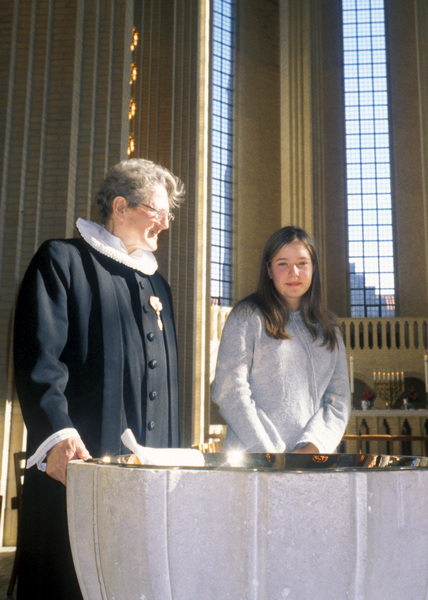
That's why
Cecilie's adult baptism - and in a way a great family
reconciliation - was a great experience for all of us in
March, while my father could still walk. But now, only six
months later, it was a major operation to get my father to
Copenhagen. And he had to rest in Inge's apartment for
several days before and after the confirmation. The trip had
been so exhausting that I thought he was dead when Inge
called me in tears to come and help him out of bed on the
day itself. His face was white and I could barely drag him
to the bathroom and carry him while he washed himself. I was
shocked to see his legs wobbling beneath him with all my
faith in the power of tea. But he wanted to go to the
confirmation, so I called Vibeke to borrow a wheelchair from
her father's nursing home, and in it we managed to wheel him
one last time into the beautiful church that had meant so
much to him in his youth. Of course, I myself was quite
moved by the situation as I sat with him in the wheelchair
right next to the baptismal font where he himself had once
baptized me.
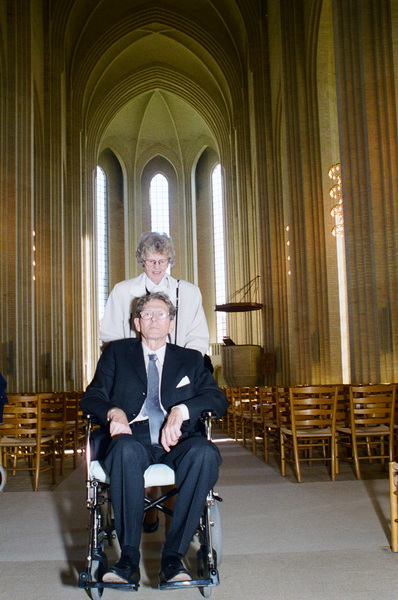
And when I
rolled him up the aisle for what I sensed would be his
irrevocably last communion - but our first together as
privates - and knelt down next to his wheelchair, well, the
tears whipped down my cheeks. He was so exhausted after
those few minutes in church that he had to be put in a bed
behind the table after the first fish dish at the
confirmation dinner, where he slept through all the songs
and never got to hear the verses that Vibeke and I had
written about him. Strangely enough, he woke up immediately
when we put cognac in front of him at Niels Jørgen's house.
But the next day he didn't wake up for most of the day. And
in a way I was a little sad about that, because it would
have meant a lot to him if he had been well enough to be
present.
Because
that very day, by a twist of fate, I had a performance in
TK's youth center, where my father, as a newly ordained
priest, had done tremendous work for the youth of Bispebjerg
and - I now found out - where he had taken care of the most
marginalized working class youth. It's still a very troubled
area. The last time I had lectured at a nearby school,
several immigrants in my audience were arrested for stealing
cars under cover of darkness during my “boring” lecture. But
perhaps because they now got to hear about my father's work
in TK, this time they sat in deep silence during the entire
show. During the set-up, I had other things on my mind when
they called from Vibeke's work and told me that Vibeke had
been hospitalized. I immediately went to Rigshospitalets
emergency room, where she was crying and in slight shock
after a new concussion. Having slipped with her bike on a
rain-soaked iron plate, she was now terrified that this
would trigger the epilepsy she suffered after her last fall
3 years ago, but which has otherwise been under control
since. The shock was worse than the concussion this time
though, even though the blow was right on top of where she
walks with a bone stump inside her brain. By the time I got
home from the TK performance, she had already been
discharged and the apartment was a sea of flowers, not least
from the staff at her recently completed festival. The fact
that the concussion, just like 3 years ago, came on her
first day of vacation and now forced her to stay in bed, is
one of life's injustices. I had to cancel the tickets I had
booked for our fall vacation in Turkey.
But I
probably would have had to cancel them anyway. My father's
stubborn insistence on coming to Cecilie's confirmation had
completely taken the wind out of his sails and ended up
killing him too. After returning home, he had practically
dozed off for a week and I started to worry that my tea
wasn't helping him after all. Fortunately, I had my last
show before the fall break at Vibe Efterskole, after which I
would be able to go home and take care of him again. And
I'll never forget this show, even though I'm a fixture in
every single one of this school's classes with perhaps the
most gifted students in Denmark. Not only was there press
throughout the show from Fyns Morgenposten (whose
enthusiastic article meant that I have received a myriad of
Funen schools in the coming time). No, the wonderful
principal couple, Birger and Groa, began without my
knowledge by having us all sing “Nu falmer skoven trindt om
land”. But this happened to be the hymn from which my father
in our childhood always used a verse as a table song:
Him we
all thank with song
For all that he has given,
For what he has made grow,
For the word and for life.
The melody
alone, hammered into my little head from early childhood,
once again made me cry like a child with the fears I was
feeling inside right now. So when I had to start immediately
afterwards, I was still so teary-eyed that I couldn't help
but start telling the students about my father. Show
business has never made me so professional that I can put my
emotions - including my lack of diplomacy - aside on stage.
But as an entertainer, you also get used to dramatizing a
bit and during the story about my father, I unconsciously
used the phrase “my dying father.” Suddenly it was as if my
own runaway words made me “face” the truth I hadn't wanted
to face before, that my father was really dying. Which of
course freaked me out even more. I saved the situation by
spontaneously changing the subject. As my lecture is about
oppression, I had prepared in advance to talk about what was
happening in Serbia at that very moment. In those very
afternoon hours, a crowd of thousands was on its way to
Belgrade to “throw off the yoke of death.” Somehow I managed
to weave it together so that in these crowds I clung to the
hope that was beginning to fade for my father. If these
people could defeat the cancer under Milosevic, my father
could defeat his. Every fifteen minutes during the slideshow
I rushed to the car radio and became more and more
excited.... the police roadblocks that blocked the advancing
masses.... the increasing numbers who joined them.... the
rush into Belgrade.... The parliament building, which was
soon set on fire.... the hated TV station, which also went
up in flames shortly afterwards, all without a shot being
fired.... yes, my excitement never ended because I could
clearly see that victory was now home.... victory for
democracy, victory for the Bosnian refugees I had
accommodated, victory over the death and destruction I had
witnessed during my visit to Kosovo.....and yes, with a
victory over such unconquerable forces, it was not
inconceivable that my father could also conquer death. So
there was no end to my excitement when, at the end of the
show, I went up in front of the students and vividly told
them about one oppression that - during the 5 hours they had
sat through my show - had now been irrevocably brought to an
end. And afterwards I sat and toasted the victory under the
black smoke clouds of TV news from Belgrade in the living
room of Birger and Groa.
Then I
rushed home from Funen to my father, about whom Inge could
now tell that he had suddenly felt better that day. He was
now able to get out of bed and sneak in and watch the TV
news with me. I wanted so much for him to experience the
victory in Serbia. I have always felt terribly sorry for
those who died in the summer of 1989 and went to their
graves unaware of the fall of the wall. The great victories
of humanity help give us all new life. And as my father sat
there with me and watched the liberating black clouds of
smoke from Belgrade pouring out of the television, he got
more and more color in his fading cheeks. Inge and I had
ordered a feast from the hotel that Friday evening to
celebrate his new courage and we had a wonderful evening
together before he went to sleep on his “Jægersborg fence”.
And when he seemed to feel even better the next day, Inge
started talking about “a true miracle.” We both agreed that
the Essiac was finally starting to work, that things were
going the right way.
I began to
sense that my “Serbian victory over death” had actually been
a rebel priest's son's rewritten form of a silent prayer to
God and that it had been heard. So I went up to Agerbæk
hotel and ordered an even bigger feast than the night before
and we set the table in the living room and even my father
drank some of the red wine and ate almost with his old
appetite. We joked and enjoyed ourselves and at one point I
even teased my father about all his wives. Suddenly he stood
up without a word and I whispered to Inge: “Well, now he's
probably offended.” But my father immediately replied: “No,
I just need to go to the toilet.” And then - without any
walking support or help - he went to the toilet himself. Now
Inge and I sat speechless and talked about how a miracle had
truly happened. Later, we sat around his bed in his bedroom
and enjoyed ourselves while he - for the first time in a
long time - started reading his latest book, John Iversen's
memoirs. When he fell asleep, Inge stayed by his side all
night, as was his long-standing habit - although suddenly it
no longer seemed necessary.
But our
happiness was not to last long. The next morning, my father
had gone to the toilet again on his own, but it took far too
long and Inge went in and immediately called me. My father
had collapsed on the toilet and Inge suddenly couldn't move
him. When I tried and felt his sudden dead weight and saw
the corner of his mouth hanging to one side, I knew he had
had a stroke. With incredible difficulty I lifted him into
bed, where we saw that his entire left side was paralyzed.
His eyes were open and following us and we could see his
fear and that he was fully aware of his situation. After
all, he had been a priest at enough of these types of
hospital beds himself. We tried to revive the fingers on his
left side, but there was no hope. Instead, he responded to
Inge's little squeezes on his right side with his own little
squeezes as they had done in their happier moments of love
and could even open his mouth for kisses when she kissed
him. We had first talked about how we would be able to take
care of him together in this new state and slowly get him
rehabilitated and discussed it on the phone with Vibeke's
mother, who trains aphasia patients. We had already
experienced the incredible home care help that came almost
around the clock. But when it turned out that my father
could no longer swallow his food, we realized in the morning
that there was nothing we could do but get him to the
hospital. I'll never forget the moment he was pushed into
the ambulance - still with his eyes wide open and staring at
me. I knew at that moment that I would never see him truly
alive again and shoulder to shoulder Inge and I stood and
cried as the ambulance drove off, crushing the miraculous
hope we had had on that happy last night before. Ever since,
I have had nightmares and guilt every time I see the back
doors of an ambulance.
After
that, Inge and I made a mistake we will probably never
forgive ourselves for. When we visited Dad at Varde Hospital
in the afternoon, he was still conscious but breathing
strangely and had a lot of fear in his eyes. He could still
respond to Inge's caresses and when he was fed by the nurses
and spilled something, he could even utter a weak “I'm
sorry”. We stayed there late into the night when it was
clear that he was anxious.
But we
hadn't given it a second thought that you can spend the
night in there and had also prepared ourselves for the fact
that a blood clot is something you stay with for a long
time. However, the next day we were told that he had been
awake and very restless and anxious all night, but in the
morning he had fallen into a deep coma. And now he had come
down with pneumonia, which - we figured - he had undoubtedly
contracted in the cold during his confirmation trip to
Copenhagen. The next three to four days would be crucial to
his survival, the doctor said. Inge and I moved into the
hospital with a bed, computer, books, etc. to be by his side
around the clock. My brothers rushed there. I myself sat by
my father's side for four days, editing his memoirs on my
computer. He had never finished them, but it seemed to me to
be the most meaningful thing I could do with my time. Inge
couldn't read, but sat around the clock stroking his hand.
It was difficult to concentrate with the noise the mucus in
his lungs was making. There was a strange incongruity in
this arrangement, however, as reading my father's memoirs
suddenly made him vivid and youthful to me, while his life
by my side slowly faded away. Again and again, passages in
the text made me suddenly want to ask him about something in
his life, why he hadn't told me before, and so on, and then
in the next moment I realized that now it was irrevocably
too late. It warmed me that it was one of his old
confirmands and a grandson of Kristoffer Jørgensen, one of
his best friends in my childhood, who took loving care of
him as a nurse and turned him every hour when his death
rattle became too unbearable. Steen brought us food every
evening after work in Aarhus and stayed there until late.
On
Thursday night, Steen and I had gone home to my father's
house to sleep, when Inge called shortly afterwards, crying
and said: “Your father has just died.” She had - as she had
done for months - held his hand when he expired at 1am. We
rushed into the hospital and waited with Inge outside while
the nurses prepared him. After four days of slow
preparation, we were resigned and resigned to the way things
were going. But when we got to Dad's room, our composure
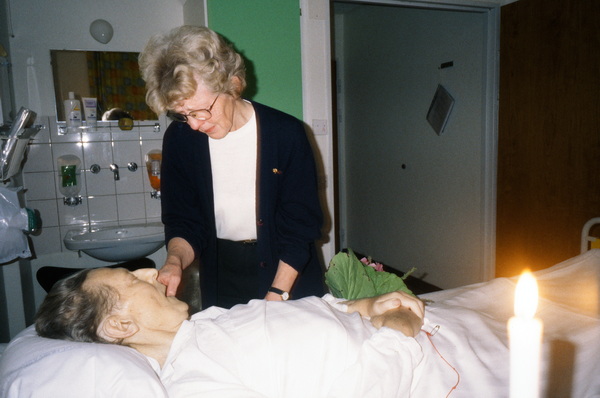
ended when we had to kiss him goodbye. Two candles were lit
by his side and in this light he looked so incredibly
beautiful and youthful. We prayed the Lord's Prayer, but it
was Inge who had to pray, as Steen and I could not remember
or find the words that my father had recited with us at the
bedside from our earliest childhood. Likewise, not much had
been passed down to us from my father's skills as a lead
singer as we squeakily tried to sing our old family hymn
“Befal du dine veje” - unable to read the words as tears
poured out. Then we had to pack all the little furniture we
had collected in this, my father's last little home and
drove quietly home in the night rain around 3 am - unable to
fall asleep at home.
The next
morning, I was up at the bakery at 7 o'clock and I didn't
understand how, but already on the way back people came out
of their houses to offer their condolences. And even before
Inge got up at 9 o'clock, all the flags in the street were
at half-mast - and soon after that in the neighboring towns
- which was good, as otherwise we would have forgotten to
put ours up ourselves. The attention made me realize that we
had to act quickly. Steen had to go back to work, so it was
up to me and Inge to prepare the funeral. Fortunately, as a
pastor's son, I had acquired a lot of knowledge about this.
I knew, for example, that the first person you book an
appointment with is not the priest, undertaker etc. No, it's
the inn. Because if the inn isn't available for coffee on
the day of the funeral, well, everything has to be moved
anyway. And since I wanted the funeral to be on a Saturday
so that my father's many friends from far away could attend,
there would inevitably be a conflict with weddings. But the
miracle happened - I got Fåborg Inn in place already before
9 that morning. Now I discovered what I had always studied
in my father, that the more you throw yourself into
practical organization, the easier it is to hold back your
emotions. I had never understood how he could bury his own
mother and wife without shedding a tear while the rest of us
sat in tears.
But from
that moment on, it was as if I suddenly inherited his
learned strength and therefore went about the funeral
preparations as if they were his - even though I normally
hate that kind of practical work. My father had left
arrangements for his funeral, but it was unclear which of
his two former assistant priests he wanted - probably
because he himself was in doubt. I asked around town - one
preferred Søe, the other Wentzel - which did not make me any
wiser. I didn't want to offend anyone and since I was sure
that Søe and Wentzel would participate as speakers in any
case, I solved the Gordian knot by choosing the priest my
father had grown fond of at his last, Agerbæk's own priest,
Rosenkrants. However, this was not an easy choice either, as
the priest who has taken over my childhood home in the
neighboring town, the Norwegian Pastor Bye, has become my
very good friend and has arranged a show for me in the
rectory and invited me to “get my childhood room back
anytime”. So he could also be a little offended as the
funeral was to take place in Fåborg church, which is his.
But I managed to solve this little knot as well. As I walked
up to the vicarage, I got talking to the gravedigger and his
wife - my father's old friends - who said that with all the
people who would come to my father's funeral, we would never
be able to be in Fåborg church, which only seats 150. Well,
I remembered how they had stood far out in the cemetery when
he buried his ex-wife, Ragna, who he would now lie next to.
This immediately gave me the idea that I could move the
ceremony to Agerbæk Church, even though the burial would
take place at Fåborg Church. This way, Pastor Bye wouldn't
be offended either, as he could then perform the burial. But
then the third Gordian knot arose: by only involving two of
my father's three old churches, the congregation in Årre
church might feel a little left out. So the idea arose -
with the fantastic diplomatic empathy I'm known for (?) -
that the funeral should take place from all three of my
father's church congregations - quite naturally. A decision
I later received a lot of praise for from all sides, but
which in reality arose because I have never in my life been
able to make a choice. And not out of any desire for my
father to have an almost majestic funeral. The fact that it
actually ended up being a bit majestic by accident didn't
bother me at all - despite my father's own modesty - as a
funeral should be for the bereaved and not for the deceased.
Now I
began to feel that I could actually master a bit of the art
of practical organization that my father was known for. So
when Bente Rosenkrants arrived later that morning to discuss
the practicalities, for the first time in my life, I felt
worthy to take my place in the executive chair behind the
big desk. I have always avoided this seat in deep reverence
for my father. Even when I looked after him this summer
while he was lying on the sofa in the office, I sat in the
living room to work rather than at his desk. Throughout my
childhood, I had sat and curled up on the wrong side of this
desk and received one admonishing speech after another from
my father with his deeply furrowed brow and almost paternal
authority: “You need to get a grip on yourself....is that
wise....what will become of you....” etc. His words still
vibrate in my head and make me crawl into a mouse hole and
feel like my whole life has failed. But now the roles had to
be reversed! With my new authority, I made sure that Pastor
Rosenkrants got as low a stool as possible “on the wrong
side of the desk” - a bit like Hitler and Mussolini in
Chaplin's “The Dictator”. She's already small and much
younger than me. And you have no idea what a joy it was to
experience the sweet hour of revenge, talking down to the
trembling, shaking little boy I envisioned. And I must
really have had some authority over me, because Bente
immersed herself so completely in the role with a
self-effacing humility - Inge is my witness - that I finally
had to make her aware of what was happening - for fear that
she would walk away having suffered irreparable damage to
her soul. So when she heard how much it meant to me to
finally “be able to talk down to a priest”, we all had a
liberating laugh, and we've actually been best friends ever
since.
And so
this whole strange next day - after the night's death - was
filled with a mixture of crying and laughter, with tears
creeping in every time you didn't do anything practical. But
the incredible thing happened, before noon the inn, two
priests involved, three churches with bell ringers and
gravediggers and the undertaker were already in place. I was
recommended the undertaker Henry Puggård from many quarters,
who was probably the greatest experience of the funeral for
us of all involved. Both he and his wife had been baptized,
confirmed and married by my father, so it meant a lot to him
to be there. And vice versa for me to have someone who had
been deeply influenced by my father. He had often had long
discussions about my father's sermons with his
father-in-law, who was one of the most prominent
missionaries of the year. But during the conversation with
him in Varde, this almost led to a crisis with Inge when
Henry told her how it was his custom to let the relatives
dress the deceased themselves along with children and
grandchildren. Inge firmly put her foot down. She had never
heard it said that children should be involved. But I could
immediately see the idea and the therapeutic aspect of it,
and I almost crushed her with all the visions this
immediately gave me. “You're from my father's generation. I
just read in his memoirs how he wasn't even present at my
birth and I almost feel insulted. But in this day and age,
no father would dream of not helping to drag their children
into this world unless they belong to some backward
country's culture. But Henry here, who was deeply influenced
by my father growing up, is one of the first to create a new
revolution, where it will be just as natural for us to drag
our relatives into the clothes for their final journey out
of this world. Can't you see that your attitude is turning
the role of the undertaker into something despicable - a
kind of scavenger who is paid to do the dirty work. But how
can this work be considered dirty when it is what you
yourself have gained dignity from over the past months,
having to dress dad every day and when you cuddled and
kissed him as much in death as in life?” Well, there was no
limit to the visions I could suddenly envision, which I
don't think even Henry himself had thought of. But I left
the matter for the time being and instead prepared to
persuade the rest of the family, who were coming in the
evening to “put the lid on the coffin”, as they say.
Suddenly, I couldn't believe that generation after
generation had resigned themselves to saying goodbye to
their loved ones by letting an undertaker put a lid on the
coffin for them after half an hour of neutral gazing at the
deceased. But as we all know, the poor who couldn't afford a
funeral director didn't do that in the old days either.
In the
evening, the whole family came from near and far and Inge
and I had ordered a feast from the hotel, because it was to
be “like the feast on the last happy evening we had with
Dad.” The three cousins had been crying non-stop for two
days now and when I got up the courage to try to get the
rest of the family on my side in the matter of Dad's attire
the next day during dinner - well, the cousins burst into
tears at the thought of having to dress Grandpa and go to
the bathroom. Fortunately, my brothers are quite
progressive, so it didn't prove difficult. In fact, even
Inge could allow herself to object, as Henry Puggård is no
stranger to her reaction and therefore leaves the family
members who don't want to join us outside in the adjoining
chapel with a door half open. And as he had said, what
always ends up happening when they hear the others - first
crying, then laughter and then a big mix of everything
around the deceased - is that they all end up joining in the
process.
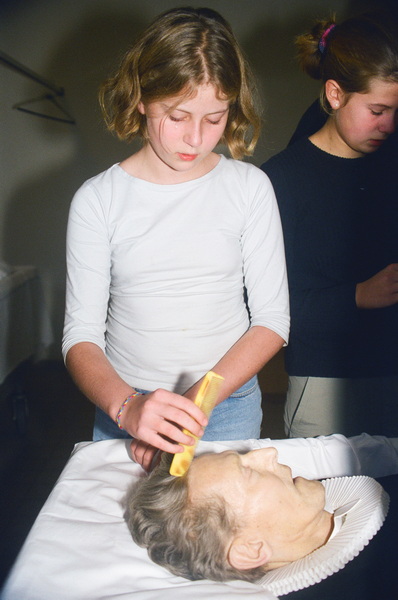
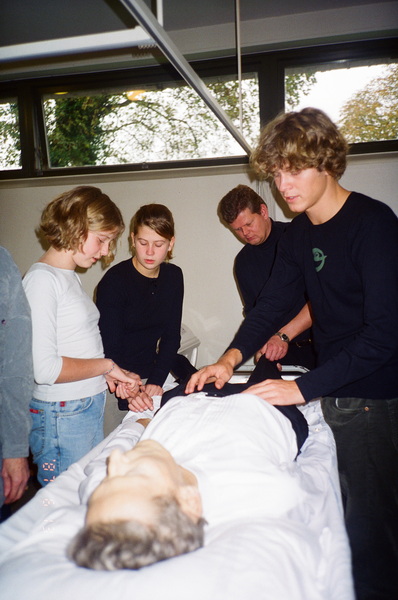
And that's
exactly what happened the next day - except that we were all
present from the beginning around Dad's naked body, covered
only by a shroud. At first we stood for half an hour at a
respectful distance and cried. We had plenty of time as
Henry would stay with us well into the night if necessary.
Naturally, those who had had the most contact with Dad in
his last dying week and had best gotten used to his new
desouled state approached him first and began to stroke,
kiss and hug him. First Inge, then me and then Steen. Henry,
who stood discreetly in the background the whole time, then
gave a wonderful little liberating lecture about why the
skin now looked ugly, about the fluids in the body, etc. If
anyone should have a Nobel Prize as a funeral director, all
of us who have been under his gentle, calm care will no
doubt nominate him.

Then we
started to dress dad. I think it was me who put underpants
on him, while Lalou and Kamilla put socks on him. I tried to
get 6-year-old Christian to tickle grandpa's toes, but he
didn't dare. Of course, we had all imagined a dead body as
completely rigid and were therefore afraid that dad's cold
arms would break when we struggled to get his white T-shirt
on and over his white shirt. But Henry reassured us that
there was no danger. Now everyone started to loosen up, to
make little jokes in the midst of crying, this whole strange
process of processing grief. That's what this whole process
was about and about having a natural relationship with
death. Henry had told me that this process had been
particularly important for parents who had just lost a
teenage son, for example. One mother had written to him that
without this therapeutic help, she would never have been
able to process her grief over the loss of her son. More
importantly, as we stood there doing the undertaker's dirty
work, it seemed to all of us - not least Inge, who had first
reacted against the idea - as the most natural thing in the
world. My father's cold skin finally felt so nice and
delicious and almost irresistible.
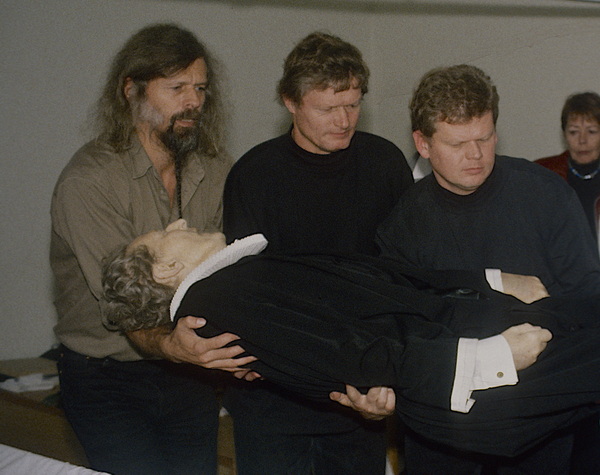
The big
moment came when he had to put on his cassock and we all had
to lift him from the stretcher into the coffin. On that
occasion, Daniel took a picture that looked almost
Rembrandt-like, with the father floating on the hands of his
three sons.
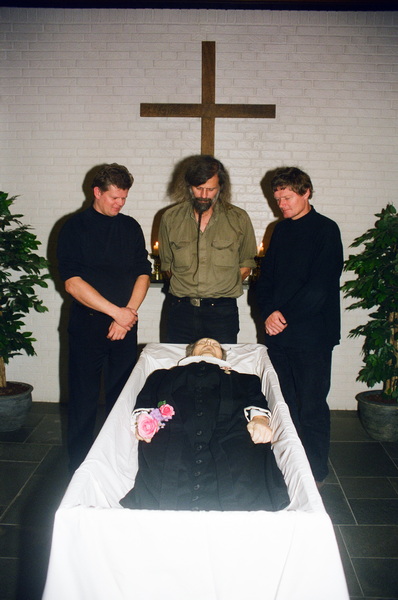
Then we
held a small devotion in the chapel, where the cousins
continued to stroke grandpa's hair, now again with tears
running at the thought of the temporary farewell of a week
while grandpa was in the fridge. We had again ordered food
from the hotel, as we did not know how long the dressing and
saying goodbye to dad would take. I picked up the food again
at the hotel from the innkeeper, who had asked the night
before: “Well, what about the food for the 80 tomorrow? Are
you coming for that too?” And on that occasion we realized
that this was the day when Dad and Inge should have
celebrated their combined 150th birthday, which we now ended
up celebrating by putting the coffin lid over one half. I
apologized profusely that in the confusion we had forgotten
to cancel the 150th birthday party.
I was now
back in Copenhagen for a week, working flat out to getmy
father's memories printedand
posted on the Internet. But scanning and selecting tons
of pictures from his life turned out to be a bigger task
than I expected. However, I did get a demonstration copy
printed. There was also a lot of work with ads, obituaries
etc. in various newspapers. I was very careful to write
“Provost Jacob Holdt” everywhere. Even so, several of
Politiken's readers were shocked to see that I was
dead at first sight and called me up. This gave me a
wonderful little taste of how people would react to my own
death.
The
funeral was, of course, as it should be. Although the
viewing from Varde Chapel was not announced for fear of
traffic chaos, a large group of my father's best friends had
found their way in anyway. Teacher Bennedsen performed the
singing out very beautifully, the speech can be seen on the
Internet. After the powerful experience of dressing my
father the week before, it now felt “like no big deal” to
put the lid on his own father. Beforehand, however, we gave
him all the gifts for the trip, letters, drawings, etc.
Vibeke returned his last Christmas present, a book by Ålbæk
Jensen, which she had struggled to get through. I had made a
large picture of Dad and Inge together, which I gave to him.
I was most sad that his deanery secretary for many years,
Inger Jørgensen, who had been such a strong support to him
(and us) during the difficult years with my mother, could
not be there due to a long trip abroad. In memory of her, I
had brought a bottle of whiskey that she had given him
during his illness this summer, but which he could not drink
at the time. I now gave it to him in the coffin. But at the
last minute I was annoyed that my father had to have the
whole bottle for himself and spontaneously unscrewed the lid
and took a big swig with the words: “I know it will be a
hard day to get through for all of us, Dad, so I need
something to strengthen me just like you now get it from
Mrs. Jørgensen on your long journey.”
(However, this was a stopgap solution on the edge of the
grave. In reality, I had tried to get this sip to man up for
the farewell on the whole drive to the chapel, but had sat
next to my mother-in-law in the car and therefore did not
dare to open the bottle).
The others
later said that for a moment it had looked like I was going
to pour the whole bottle over dad, but I'm not that crazy.
On the other hand, I had learned how important humor is for
processing grief and this made it a little easier for all of
us to irrevocably put a lid on dad immediately afterwards.
During the long funeral procession, which got longer and
longer as people joined in, I sat in the front of the hearse
with Puggård. We both had cell phones to direct various
ringers in the towers of the various churches and the like.
I had laid out and measured the route around Gunderup so
that we could enter Årre from the right side. I didn't want
anyone to feel cheated and go off half-cocked or lay out
spruce branches in vain. I wanted my father to have the
opportunity to say goodbye to all three church congregations
that had meant so much to him. As soon as we drove into Årre
town, we heard the church bells and the whole long road up
to the church was covered with yellow flowers. Here I drove
the hearse up to the memorial service in front of the church
on the hill, where the large congregation stood in line in
front with bowed heads during the ringing while the now long
cortege had to stay below. It was a beautiful farewell and
as always, it was me who broke the ceremony by jumping
around in confusion to photograph it all. Photography -
standing at a distance from the action - is a great way to
hold back the tears. Once everyone was in the cars, we drove
on towards Fåborg.
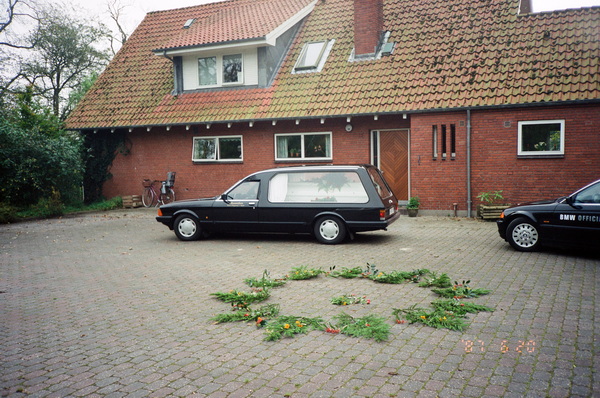
Here, all
the carriages with the family drove up to the vicarage along
the long elm avenue, which was beautifully covered with
yellow flowers. Out on the road itself, my childhood friend
from the age of 3, Jens, had laid a spruce and flower
carpet. This is where he and Niels Jørgen and I as boys were
always told by our father to lay out a spruce blanket every
time there was a funeral for someone in town. The much
heavier traffic these days has meant that people now put
flower carpets inside their driveways instead. In the middle
of the courtyard, Pastor Bye and his wife had made a huge
round flower arrangement that we now circled the wagons
around as we said goodbye to our childhood home. This was
one of the many times during the day when I and - I think -
both my brothers had to burst into tears, because the
vicarage had not only been the setting for our childhood,
but also for the incredible popular work my father had
created around it and in it. At Fåborg church, we stopped
again to pick up neighbors, including Marius' parents, Niels
and Frida. In Agerbæk, I parted in the hearse from the now
mile-long cortege - officially to let my father say goodbye
to his last home on Debelvej, which was now like a long
flower carpet - unofficially because we had discovered in
the chapel that in the confusion we had forgotten the
Knight's Cross, which is part of a funeral in these parts.
Although my father's death had given me a strange freedom to
suddenly rummage through all his drawers, I never imagined
that - before he was even buried - I would end up ripping
out so many drawers as quickly as I did to find his knight's
cross. But I succeeded and my new friend, Henry, quickly put
it on the coffin so we could reach the church in dignified
and exalted calm, where all 300 people were now waiting in
front of the church.
And funerals are a strange thing, because even if you, like
me, feel that you've had ample opportunity to cry out during
the long course of his illness and personally thank your
father at his bedside, - well, the ceremony and the
atmosphere still makes you burst into tears when you have to
carry your father past all these people with all their
different feelings towards him from a long life together.
One reason I had chosen Bente Rosenkrants was that she has a
lovely, light and smiling way of preaching (her beautiful
speech is on the Internet) and when it came to an
80-year-old I wanted it to be a celebration. Yet my tears
kept betraying this celebratory mood. I also knew almost
exactly when it would happen - like when we had to carry the
coffin out of the church to the tune of “Så rejse vi til
vort fædreland” - the hymn we had hung with pictures
illustrating each verse up the stairs to my room in the
vicarage. But shortly afterwards you are able to function
normally again - like when I saw that many outside the
church did not have a car, not least the 80-year-old teacher
Jessen, who was also the father of Ingrid, my girlfriend in
high school - and got them a car. Now the whole long cortege
had to drive back to Fåborg church, where I and my brothers
and Daniel and my father's two best neighbor friends carried
the coffin across the cemetery with the two ordained priests
in front of us and numerous neighboring priests behind us.

As I
slowly read the names on the gravestones, I couldn't help
but wonder how many people would have attended the funeral
if it had been 10-15 years ago. Because here was my father's
entire generation - the pillars of my childhood - Brosbøl,
Søndergård, Abrahamsen, etc. as well as many of my own
schoolmates like Henning, Bruno, Bjarne, Finn, Lise, “kjøn
Erik”, Peter Ludvig, etc. After the burial, which is the
moment I hate most at funerals, all the participants filed
past and greeted us in the family, all as one with sad
faces. But as the line was half an hour long, it was hard
even to maintain an appropriate grimace towards the end. I
hadn't seen many people in years and it was embarrassing to
have to ask them who they were, but luckily Niels Jørgen was
ahead of me so I could listen in when he made a fool of
himself. Others, like my father's good friend, Ivar Hansen,
I had plenty of opportunity to see again during the summer's
illness.
Finally
came the highlight of it all, the grave coffee at the inn. I
won't try to describe this phase, where the boil has passed
and everyone is in high spirits, with the traditions
associated with it in West Jutland, as my father has done
much better in his memoirs, which you can see on the
Internet. I had been down to the inn myself in the morning
to decorate and set up a small memorial where people could
sign up for his book of remembrance. I'm also going to put
all the speeches on my father's memorial site on the
Internet when I get time. It was mostly the many pastors who
gave speeches besides us three brothers. Pastor Wentzel
suggested that my father's funeral speeches, which were
particularly famous, should be published. During Steen's
speech, his ex-wife got angry at what he said and walked out
and Niels Jørgen spent a lot of time, as usual, berating his
older brother and complaining about all the gardening we had
had to do in the large rectory garden in our childhood. I
didn't know what to say about my father, who in many ways is
still a mysterious shadow that follows me everywhere. So I
told a little about the unknown aspects of his life that I
had just experienced while reading his memoirs. We all
thanked Inge for her sacrificial love, while I didn't forget
to send a touching greeting from Dad's ex-wife Rie in
America, whom I visited later in the year to report on the
funeral in person. And not least, we thanked Henry Puggård
for giving “us all an experience of a lifetime.” His
father-in-law came up afterwards and thanked us for all the
kind words. Incidentally, this was a Gordian knot I never
managed to solve despite my great diplomatic skills - that
Pastor Rosenkrants' own husband, who was present, owned the
area's only competing funeral home. Apparently it's easier
to distribute a body among many priests than among many
undertakers.
But now
New Year's Eve is approaching and I have to get this job
done. Vibeke's much-needed vacation had been ruined by a
concussion and death, and I was about to leave for the US.
Because of my statements about immigrants on the TV news,
the Nazis threatened to kill my family just before
departure, so Lalou was a little nervous that the Nazis
would crawl in to her via the scaffolding in front of the
house that was being painted. Admittedly, I had no shows in
the US as the schools had all preferred to postpone until
spring, not knowing when my father would die. But there was
so much rust in my car over there that it couldn't pass
inspection in Massachusetts and had to be registered in New
York. I also did research in the major libraries in NY,
Washington and Los Angeles, the latter where I was kicked
out of a polling station for disparaging Bush.
I also managed to spend a day at Scientology's big
propaganda headquarters in the desert with movie studios as
big as Hollywood, all financed by the poor people they
plunder around the world. The greatest experience was
researching in the posh Library of Congress, where, Kasele,
one of my old beautiful black students now worked. I will
never forget how she stood for a long time after the show,
trembling, even shaking all over with movement. And I
relived that many years later in a very special way when she
led me into the kilometer-long corridors with books, where
no ordinary mortals like me are allowed to go. But wherever
we went, the black employees recognized me and greeted me
“Hello, Mr. Holdt.” I was mildly surprised at their
literacy, but it turned out that Kasele had been telling
them about me for years and getting them to read my book.
Why they also persuaded me to donate more copies, as one of
the library's two copies had now disappeared - probably for
the same reason. That's why I couldn't get a better
assistant for my research than Kasele, who served only one
customer during all the days I was there: me. Even though I
wrote out stacks of orders for books I needed, she ran
around all day long to find them in the three buildings that
spanned several of Washington's major avenues. But such
long, winding corridors are also ideal for flirting, as
Vibeke was the first to realize when I came home and showed
her pictures of Kasele's beauty.
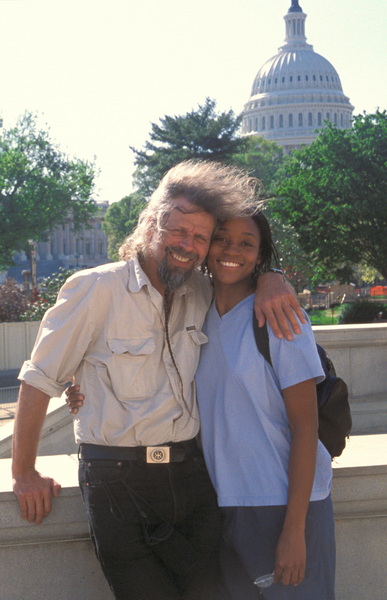
In the
evenings, I thanked her for her efforts by taking her to
concerts or restaurants. The other thing I was researching
was a new book Gyldendal has asked me to write about my
predecessor Jacob Riis. A project that seems a bit more
manageable than my world history, but let's see if I can
make it happen. In any case, it will be written as a bit of
a self-reckoning, as both Vibeke and I have found far too
many unpleasant similarities between Riis and me - mostly in
a negative direction. However, I was far from finished,
because in the middle of all the fun, Vibeke called one
night to say that my ex-wife Annie was dying at home and
wanted to see me first. It was a bit too much death in one
month. I'd had nightmarish dreams about my father throughout
the trip to the US, which still kept me awake. That night, I
dropped everything and drove up to New York to catch a
flight home the next day. As I drove towards the airport,
however, the traffic was so congested that I decided to take
a shortcut through the West Indian ghetto in Brooklyn. But
here the engine suddenly exploded in smoke and steam and I
lost the automatic steering. So instead of ending up with a
couple of cold Icelandic stewardesses, I ended up with a
couple of hot-blooded Trinidadian mechanics and didn't get
home until the next day. I went straight from the airport to
the hospital. Annie was completely worn out from diabetes
and all sorts of related illnesses and was in terrible pain
when I entered. But after some time her condition improved
and she seems to be coping. She still has her sense of
humor. She thinks it's terrible to end up in a ward when
there is such a cozy life with lots of people out in the
crowded hospital wards. But she also speaks as a contrast to
the lonely life she normally leads in her everyday life in a
sheltered accommodation, where she only has my Christmas
letters to look forward to, as she says. And then you know
that she must be miserable.
And so it
was Christmas again after a year that - a little too much -
was dominated by family. Next year I will try to live a
little more outgoing. In March, it's the 25th anniversary of
American Images and to mark the occasion, I've launched a
new “Millenium” edition in which I try to deal with our own
racism in Denmark - a “therapeutic show.” I've also teamed
up with the newspaper Politiken, which will use it in its
own campaign against racism and, among other things, be
behind a big birthday event on March 29 in Diamanten (Det
Kgl. Bibliotek). Even if you've seen the old version, I hope
to see many of you at this event. But there are more 25th
anniversary events you can join us for. On Saturday, June
23, for the first time ever, I'm opening a photo exhibition
of my “dead” photos - also from the Third World - in the
Round Tower. For many, it's the first day of vacation, so I
think you should change your vacation route to Copenhagen
and use the occasion for a summer party. You only got three
days' notice for the bridge race party, but this time you've
been warned six months in advance, so it's harder to find a
good excuse for not showing up! Have a very happy new year.
With love
and best wishes
Jacob
Holdt
Gernersgade 63, 1319 Copenhagen K
Phone. 33-124412 , Mobile when on tour: 20-324412 (In USA:
212-614-0438)
E-mail:
jacobholdt@american-pictures.com
Special web pages under
www.american-pictures.com/..... :
Previous Christmas letters:
.../Danish/jacob/julebreve.htm (with this year's
pictures)
Memorial site for my father:.../Danish/jacob/far/Provst.Holdt.htm
My father's memories:.../Danish/jacob/fars.erindringer.htm
My running in Denmark:.../Danish/jacob/motion.htm
My mentioned genealogy pages:
..../genealogy/saints.htm
List of my lectures, locations and dates:
..../calendar/lectures.htm
Remember
to email me your email address today!
Back to part 1
Back to index
|